The 6 Stages of Play: How Children Learn to Play Together at Daycare
Published: October 21, 2026 · Last updated: October 26, 2026
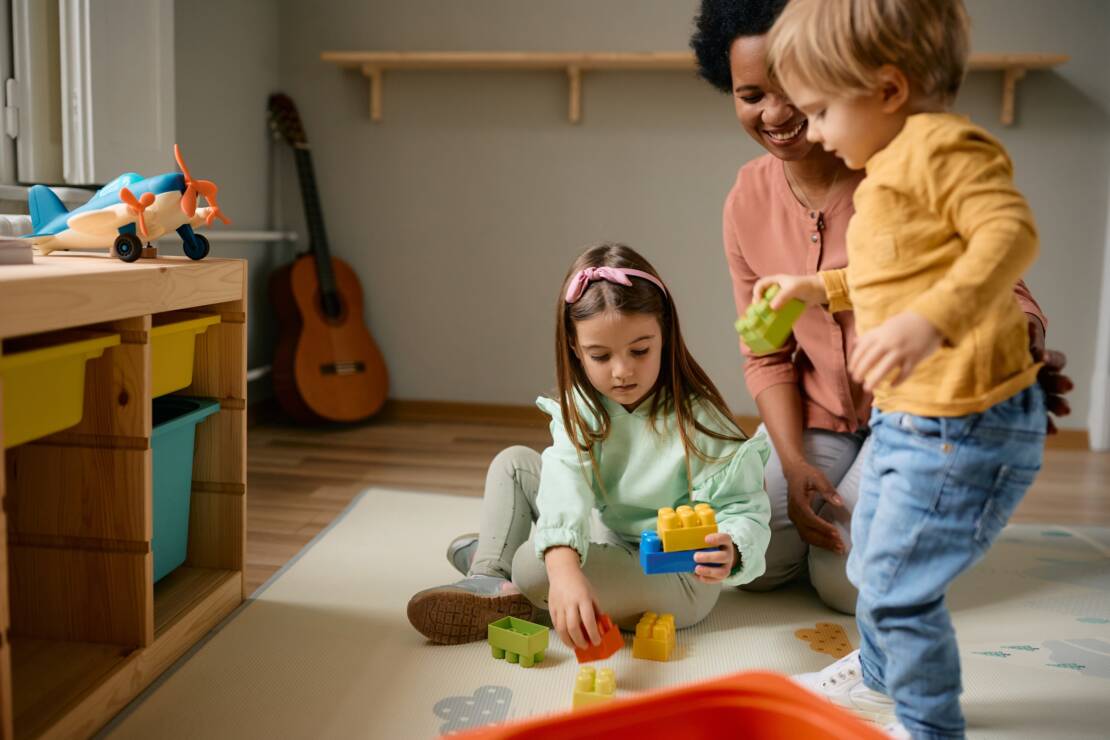
Children learn to play with each other in stages, starting with watching and playing alone, then playing side by side, and later sharing ideas and roles with friends. The stages overlap, so your child might build a tower on their own in the morning and run a pretend restaurant with two classmates after lunch. When each stage shows up comes down to your child’s age and temperament, and how much time they spend with the same group of kids.
If your child goes to daycare, chances are you’ve had a photo like this one pop up on your phone: two toddlers on the rug, each pushing their own truck, not even looking at each other. Are they friends? Do they even know the other one is there? They do, and what they’re doing has a name: ‘parallel play.’ It’s one of six stages children go through before they play together as a group, and we’ll go through all of them below, with the age each one usually shows up, what it looks like at daycare, and what teachers do to help.
What are the stages of play?
The six stages of play are: unoccupied play, solitary play, onlooker play, parallel play, associative play, and cooperative play. They were first described by Mildred Parten, an American researcher, back in 1932. Kids go through them more or less in that order, from watching and playing alone to playing together with a shared plan, but the stages overlap quite a bit, and development varies from child to child..
| Stage | What it looks like | When it usually shows up |
| Unoccupied play | Your baby looks around, kicks, waves their arms and grabs at whatever is close | The first months |
| Solitary play | Your child plays alone with their own toys and doesn’t pay attention to other children | From infancy, and at every age after that |
| Onlooker play | Your child watches other children play, and may talk to them, without joining in | The toddler years |
| Parallel play | Two children play next to each other with similar toys, but not with each other | Around 2 years old |
| Associative play | Children play in a group and share toys, but each one follows their own idea | Around 3 years old |
| Cooperative play | Children play toward one goal, with roles or rules | Around 4 to 5 years old |
The six stages of play, one by one
Interestingly enough, Parten only saw cooperative play happen now and then, even with the oldest children she watched, so don’t worry if group games take a while for your little one to warm up to. Some kids are more introverted and prefer playing alone, while some enjoy more time playing with others.
Kids spend years in the first five stages, and each stage teaches them something they need going into the next one. The American Academy of Pediatrics recommends making time for play every day for exactly this reason, since it’s how young children practice language, problem-solving and getting along with others.
1. Unoccupied play
Unoccupied play is the earliest stage, when a baby isn’t playing with anything in particular yet. They look around, kick their legs, wave their hands around and grab whatever’s within reach. It usually shows up in the first months, and by 6 months old, that waving turns into reaching for the toy they want.
Those movements are basically how babies figure out how their own arms and legs work and what happens when they kick or grab something. Every wiggle is practice for rolling over and sitting up, and later on for holding a toy long enough to play with it.
In the infant room, teachers give babies plenty of floor time on a mat, with a few toys within reach and other babies close by, and they chat with each baby about what they’re looking at and touching. You can mirror this activity at home with tummy time on a blanket and a toy placed just out of reach, so your baby has a reason to stretch for it.
2. Solitary play
Solitary play is when a child plays on their own and pays no attention to the kids around them. Think of a 1-year-old banging two blocks together, filling a bucket and tipping it out again, or flipping through a colorful book for a few minutes. It’s the usual way babies and young toddlers play, up to around age 2.
And no, this stage doesn’t stop when the next one starts. Plenty of 4- and 5-year-olds still pick a puzzle or a drawing by themselves, and that quiet time teaches them to concentrate and finish what they started. It’s also how kids learn to keep themselves busy without an adult in charge, which any parent who has tried to cook dinner with a toddler around will appreciate.
That’s why teachers keep a quiet corner or a table in every room, where a child can play alone without anyone interrupting. At home, it helps to keep a small basket of toys on a low shelf, so your child can grab what they want without asking you. When they get stuck on a puzzle, try counting to 20 in your head before you jump in. Plenty of times, they’ll work it out on their own.
3. Onlooker play
Onlooker play is when a child watches other children play but doesn’t join in. They might stand close, ask questions or laugh along, without ever touching the toys. You’ll see lots of this in the toddler years, especially in a child’s first weeks with a new group.
Your child is still learning while they watch. Toddlers are curious and they like to see how a game goes before they try it, and while they’re watching, they pick up new words and new ways to use a toy, all from the sidelines.
Teachers let the little ‘watcher’ stay put and talk about what the others are doing (‘Look, Maya is pouring sand into the cup!’), so the child can jump in whenever they feel ready. If your toddler hangs back at the playground, you can do the same thing. Stay close, tell them what the other kids are up to and let them decide if or when to go over. We’d also suggest playdates with just one other child at this age, since a big group can be a lot to take in.
4. Parallel play
Parallel play is when two or more children play next to each other with the same kind of toys, but not with each other. Picture two toddlers at the sand table, each filling their own bucket, or two kids at the same table, each busy with their own drawing. They don’t say much, if anything, but they keep an eye on each other and often copy what the other one is doing.
Parallel play usually starts around age 2, and the CDC’s milestones for 30 months sum it up nicely: ‘plays next to other children and sometimes plays with them.’ It’s the main way 2-year-olds play together, and it carries on alongside the later stages for years.
This is the stage where children first learn from each other. When your toddler copies the child next to them, they’re picking up new ways to play and new words, and they start to see that other kids come up with fun ideas, too. Sitting side by side also gets them used to sharing space with other children, which comes before sharing toys.
At this age, teachers make sure there are two or three of their favorite toys available, like dump trucks or baby dolls, so nobody has to share just yet. They’ll also set up activities kids can do side by side, like a water table or a long roll of paper on the floor for everyone to draw on. The same trick works for playdates at home. Put out two buckets in the sandbox or two boxes of crayons, and don’t worry if the kids barely say a word to each other. That’s what playing together looks like at 2 years old.
5. Associative play
Associative play is when children play in a group, share toys and talk to each other, but without a shared plan. Say three kids are in the toy kitchen together, swapping pots and chatting away, but each one is cooking their own dinner. Or a group runs around the playground pretending to be dinosaurs, and nobody has agreed on who’s who or what happens next.
This stage usually shows up around age 3, when the CDC expects children to notice other children and join them to play. The difference from parallel play is that the kids are now playing with each other, even if each one still follows their own idea.
Associative play is where sharing gets real. Children practice asking for a toy instead of grabbing it, and they learn to wait when the answer is ‘not yet.’ They also make their first friends, so you might start hearing the same names at dinner every night. And with all the chatting that goes on, their language also gets plenty of practice.
In our twos room, pretend play happens every day, and that’s where you’ll see the first group games start. Teachers set up pretend-play corners with room for a few children at once, and say out loud what each child is up to (‘You’re making soup, and Leo is baking a cake’). Once kids hear it, they start to notice each other’s ideas and add to them. At home, toys without one right way to use them, like blocks, a toy kitchen or a dress-up box, let several kids play at once without needing a plan. And when a squabble starts, give your child the words first (‘Can I have it when you’re done?’) before you step in and sort it out for them.
6. Cooperative play
Cooperative play is when children play together towards a shared goal. They agree on a plan, hand out roles and follow rules. It usually starts around 4 years old and picks up in the year before kindergarten. By age 4, the CDC says children will ask to go and play with other kids if there are none around, and by age 5, they can follow rules and take turns in group games. Compared with associative play, the big change is the shared goal, since the whole group is working on the same game or project and everyone has a part.
This stage brings together almost everything children have practiced so far. They learn to negotiate, to wait their turn and to lose a game without falling apart. Playing a role also teaches them to see things the way someone else does. Kindergarten teachers count on these skills from day one, whether it’s working in a small group or following the rules of a classroom game.
In our preschool rooms, teachers give small groups a shared project, teach them simple games with rules and help them talk it out when they disagree, instead of just grabbing the toy back. At home, board games with short turns, like Candy Land, are a great place to start. So is a pretend shop where your child sells and you buy, or a couch-cushion fort you build together on a rainy weekend. And yes, let them lose sometimes. It’s a lot easier to learn that at the kitchen table than in a room full of classmates.
How the stages of play line up with daycare rooms
Illinois licenses daycare rooms by age, with a set number of children per teacher and a largest group size for each age. Since kids are grouped by age anyway, each room ends up with its own mix of play. Here’s how the stages match up with the rooms at LadyBug & Friends:
| Room | Ages | Children per teacher, largest group | Stages you’ll see |
| Infants | 6 weeks to 15 months | 4, up to 12 | Unoccupied, solitary, onlooker |
| Toddlers | 15 to 24 months | 5, up to 15 | Solitary, onlooker, first parallel play |
| Twos | 2 to 3 years | 8, up to 16 | Parallel, first associative play |
| Preschoolers | 3 to 6 years | 10, up to 20 (for 3-year-olds and 4-year-olds) | Associative, then cooperative |
Illinois also sets out what preschoolers should be learning, and two of the state’s early learning standards are ‘Engage in cooperative group play’ and ‘Begin to share materials and experiences and take turns.’ Both start at age 3, which means playing together and sharing are things children learn in preschool. So, if your toddler won’t share, don’t worry, nobody expects them to yet. In the twos room, you’ll hear the first ‘my turn!’ and see the first trades. By preschool, teachers bring out a sand timer or a waiting list for the popular toys.
What the stages look like in your daycare photos
We send parents photos through our parent app during the day, and they’re a handy way to spot which stage your child is in at a given moment. Two toddlers side by side, each with their own blocks? That’s parallel play. Three kids in the toy kitchen, one stirring, one setting the table and one wandering off with a spoon, are in associative play. And when a group sits in a circle for a game and waits for their turn, that’s cooperative play.
At pickup, try asking the teacher:
- Who does my child like to sit or play next to?
- Where does my child go first in the morning, and do they play there alone or with others?
- Has my child joined any group games this week?
Is it normal for my child to play alone?
The short answer is: absolutely. Children play alone at every age, and some kids enjoy time on their own more than others do, it’s part of their personality. That being said, if your child is 3 years old and shows no interest in other children at all, mention it at their next checkup and bring the CDC’s milestone checklist with you.
At LadyBug & Friends, children from 6 weeks to 6 years old spend their days with the same group of classmates at nine daycare centers in the city and the suburbs, with doors open from 7am to 6pm. Pretend play, group time and outdoor play are part of every day in our toddler, twos and preschool rooms. Come and see our rooms during morning play, and watch which stage your child heads for first.
Frequently asked questions
What age does parallel play start?
Parallel play usually starts around age 2 and is the main way children play together until about 3. Kids still play side by side at 4 and 5, too, especially when they’re trying something new.
What is the difference between parallel play and associative play?
In parallel play, children play next to each other but not with each other. In associative play, they play in a group, share toys and talk, but each child still follows their own idea, so there’s no shared goal.
When do toddlers start playing together?
Short moments of playing together start around 30 months, often in pretend play or chasing games. Longer group play, where children talk to each other and share toys, usually comes around age 3.
Who came up with the stages of play?
Mildred Parten, an American researcher, came up with the six stages after watching children ages 2 to 5 at play in the late 1920s. She published her findings in 1932, in a paper called ‘Social Participation among Pre-school Children.’
Do children go through the stages of play in order?
Roughly, yes, but not strictly. The stages overlap, and children move back and forth between them during the same day, depending on the activity, their mood and who they’re playing with.
Is cooperative play the same as playing games with rules?
Games with rules, like tag or Simon Says, are one kind of cooperative play. Pretend play with roles, like playing store, is another, and so is building something together.
Get Enrollment Information and Register for our Tours & Waitlist…
Other News
Is Pre-K the Same as Preschool? What’s the Difference in Illinois?
Confused by preschool and pre-K? Compare ages, Chicago enrollment cutoffs, and classroom e …Separation Anxiety at Daycare, When it Starts and When It Gets Easier
Separation anxiety usually starts around 9 months and returns in toddlerhood. Learn when t …What Age Does Preschool Start?
What age does preschool start? Typical ages from 2 to 5, what changes when a child turns 3 …How to Prepare Your Child for Daycare, Week by Week
How to prepare your child for daycare, week by week: Illinois health forms, moving naps an …What to Expect from Infant Care at Daycare: A Parent’s Guide
A complete guide to infant daycare in Chicago: ratios, daily routines, bottles and meals, …How Daycare Waitlists in Chicago Work and When to Apply, By Age
Daycare waitlists in Chicago run longest for the youngest children, since state ratios kee …More News