What Age Does Preschool Start?
Published: September 22, 2026 · Last updated: September 22, 2026
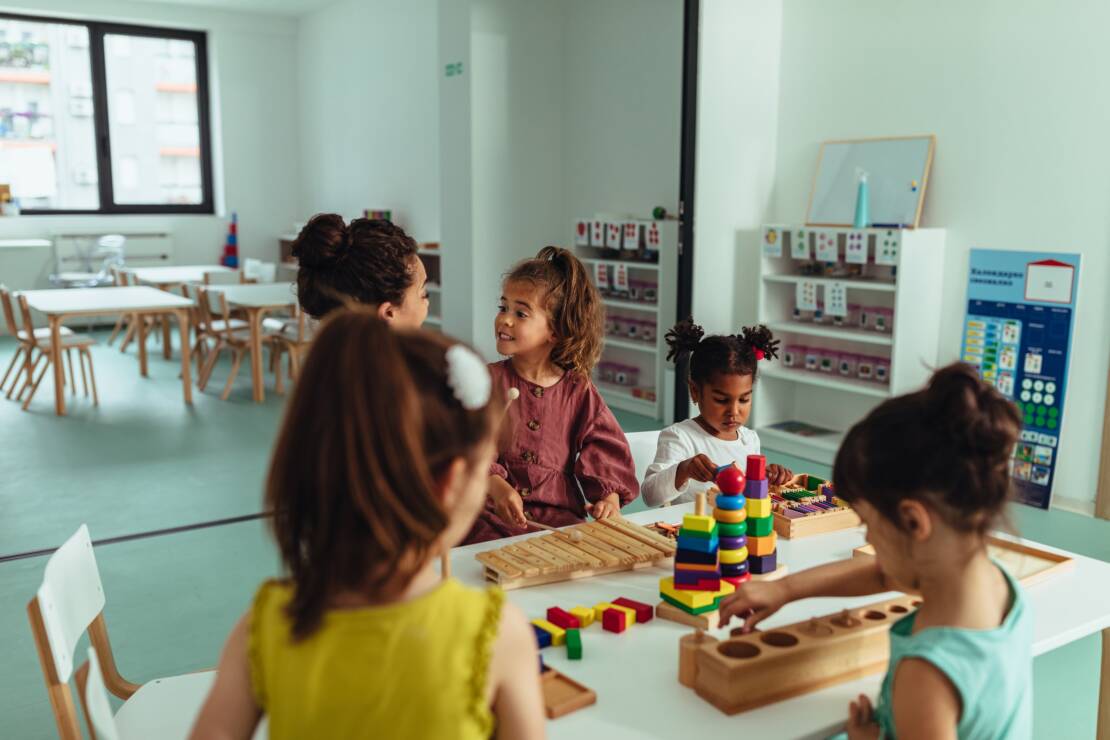
Preschool usually begins at 3 and runs to 5, and some centers open a twos room a year earlier. Which room a child joins depends on their age, the state’s staffing rules and where a space opens up. When to start depends on your child’s birthday, the kindergarten cutoff where you live and how much of the day your family needs covered.
Ask five daycare centers what age preschool starts and there’s a good chance you’ll get five different answers. In Illinois, what settles the confusion is a set of staffing rules that change on a child’s third birthday, and centers have to build their classrooms around them.
This guide walks through the ages year by year, explains how to line preschool up with the kindergarten cutoff, whether preschool is required at all, and what happens if your child turns 3 in February rather than in August.
When is the right time to start preschool?
Preschool usually starts at age 3 and lasts until a child begins kindergarten at age 5, with the last year of this span often called pre-K. Numerous childcare centers also have a classroom for children who are 2 years old.
Licensed centers in Illinois may enroll children in any of these age categories. The state requires different adult to child ratios depending on the children’s age, and this rule causes classroom changes to generally line up with a child’s birthday.
| Age | Room at a licensed Illinois center | Staff to children | Largest group allowed |
|---|---|---|---|
| 6 weeks to 15 months | Infants | 1 to 4 | 12 |
| 15 to 24 months | Toddlers | 1 to 5 | 15 |
| 2 to 3 years | Twos | 1 to 8 | 16 |
| 3 years | Preschool | 1 to 10 | 20 |
| 4 years | Preschool or pre-K | 1 to 10 | 20 |
| 5 years | Pre-K or the kindergarten year | 1 to 20 | 20 |
Ratios and group sizes come from the Illinois licensing standards for day care centers. The regulations identify the two youngest age groups as 6 weeks through 14 months (infants) and 15 through 23 months (toddlers). So, a child shifts to the older group on their 15-month birthday.
Preschool, pre-K and the twos room: what the names mean
A preschooler refers to a child aged 3 to 5 who has not yet begun kindergarten. Pre-K covers the final year of that range, typically 4 to 5, and its curriculum focuses on letters, numbers, writing the child’s own name, and participating in a longer group activity – basically preparing the child for kindergarten. A twos room is positioned between the toddler room and preschool and enrolls children aged 2 to 3.
Names tend to vary from one center to another. One center might label its 4-year-old room ‘pre-K,’ another ‘Preschool 2,’ and a third might combine 3s and 4s in a single room called ‘preschool.’ The best way to avoid confusion is to schedule a tour and ask about the ages of children in the room your child would enter and the number of children present, instead of focusing on the room’s name.
Why the preschool room usually starts at 3 years old
In Illinois, staffing ratios shift when a child reaches age 3. A room serving 2-year-olds must have one adult for each eight children, and the group may not contain more than 16 children. For 3-year-olds, the required ratio is one adult per ten children, and the group size limit is 20. In mixed-age groups, the youngest child sets the ratio and group size. So, if a center places a single 2-year-old into a room of 3-year-olds, the whole room must adhere to the one to eight ratio.
When a daycare center tells you it cannot enroll your child until their birthday, it’s just following the licensing category assigned to that room. Basically, a room with 16 two-year-olds requires two teachers. When that group reaches age 3, the same two teachers can supervise 20 children. This lets the center offer spots to four more families while keeping the staffing level unchanged. Centers schedule enrollment a year ahead using these calculations.
Licensing for Illinois day care centers moved from the Department of Children and Family Services to the new Illinois Department of Early Childhood on July 1st, 2026, and the ratios carried over unchanged.
Starting preschool at 2 years old: what a twos room does differently
A classroom for two-year-olds differs from a preschool classroom, as they have fewer children per teacher and smaller overall group sizes. The daily schedule also takes shorter attention spans into account, with group activities lasting only a few minutes rather than half an hour. Art projects emphasize the sensory experience of using materials like paint or watercolors, instead of focusing on the final product, and children are not required to practice writing letters. Instead, they learn to adjust to the routine of a school day. This preparation makes sure they are comfortable in a classroom environment before they join a group of 20 children the following September.
At 2 years old, much of what a child gets out of preschool is social. They take turns for the first time, sing the same songs with the same friends every morning, and sit down to play and snack as a group. The day itself is a shorter version of a regular preschool day, so circle time runs about 10 minutes instead of 25, projects are a one-time thing, and everyone still takes naps. In a regular preschool room, that becomes a quiet rest or break time, and some children skip it entirely.
As for potty training, it’s usually not a condition of joining a twos room at a private center, though public preschool programs often do ask for it. We get into that in our comparison of private and public preschools in Chicago.
At LadyBug & Friends, our twos program runs from 2 to 3 years old, for 2, 3 or 5 days a week, so a family can start with two mornings and then build up.
What about the kindergarten cutoff?
In Illinois, public school districts require a child to be 5 on or before September 1st to start kindergarten that month, under the state school code. Private schools set their own entry ages, though many follow the same date.
Let’s take two children, born seven weeks apart:
- A child who turns 3 in August 2026 turns 5 in August 2028, clears the cutoff with days to spare, and starts kindergarten that same month. Two years in preschool rooms.
- A child who turns 3 in October 2026 turns 5 in October 2028, misses the cutoff by a few weeks, and starts kindergarten in August 2029. Three years in preschool rooms.
A spring birthday is the easy case: a child who turns 3 in March 2027 moves into a preschool room that spring, and starts kindergarten in August 2029 at 5 and a half.
Both outcomes are acceptable, yet you need a plan for a child born in October. Ask the center how they engage an older 5-year-old during that extra year, and whether the pre-K curriculum becomes more advanced for these students or simply repeats the same material. School districts often carry out their own assessments for early entrance when a child is near the age cutoff. Contact your local district to learn about its specific evaluation process.
Starting preschool at 4 years old
A child starting preschool at 4 years old goes straight into the same room as children who have been there a year, and the ratio does not change: one adult to 10, up to 20 children. What they miss is a year of the routine, not a year of the curriculum, and teachers are used to it. The first month is usually an adjustment period, during which the child gets used to the routine and the room environment.
Ask two questions when you enroll at 4 years old. First, whether the room mixes 3s and 4s or keeps them apart, because a mixed room means your child won’t be the only newcomer.
Second, you need to understand the curriculum for the pre-K year. This allows you to decide whether your child will get a complete education in literacy and numeracy or a shortened version. A 4-year-old who starts preschool in September has a full year before entering kindergarten, which provides enough time. A 4-year-old who begins in April will only complete one term, so this shorter period functions more as an adjustment phase than a full year of academic preparation.
Does my child have to go to preschool?
The short answer is no. School attendance in Illinois is compulsory from age 6 on or before September 1st, under 105 ILCS 5/26-1. Nothing requires a 3-year-old or a 4-year-old to be enrolled anywhere, and nothing requires a 5-year-old to be in kindergarten either.
However, the years before school give children practice with skills that are hard to acquire at home with only one adult and no peers. Those skills involve waiting for a turn, cooperating in a group, following directions meant for 15 children at a time, and receiving care from someone other than a parent. Our own curriculum is created based on the particular needs of kindergarten teachers, so our preschool room has a more structured environment than the room for two-year-olds.
It’s also not an ‘all or nothing’ type of decision. Many families who are uncertain start with two or three days of preschool each week. This method gives children group experience while not needing a full-time schedule. It also helps in lowering transition difficulties and separation anxiety for both children and parents.
When in the year can a child start preschool?
There are two systems running side by side, and they behave differently. A preschool attached to a school district takes one intake a year, in August or September, with applications the winter before. A privately run center moves a child up when they turn 3 and a space exists, in any month.
So, a child who turns 3 in February can move into the preschool room in February at a private center, or wait until the following August at a school-calendar program. That’s the difference worth checking before you join a waitlist, because it can add up to six months of waiting. How far ahead to apply depends on the age you’re applying for, and we set out the real timelines in our guide to how daycare waitlists in Chicago work.
Signs your child is ready, whatever their age
The American Academy of Pediatrics describes a typical 3-year-old as a child who can be understood most of the time, talks more with other children while playing, is beginning to follow simple rules, and wants to do things on their own. Those four are a fair picture of what a preschool room is built around.
Alongside them, there are the practical signs teachers mention on tours:
- Your child can manage a few hours away from you, even if they protest at drop-off
- They can tell an adult what they need, in words or by pointing at things
- They can follow a two-step instruction, such as shoes off and coat on the hook
- They play alongside other children rather than only next to their own toys
- They nap or rest on a roughly predictable schedule
If some of those are not in place yet, it doesn’t mean that your child is behind. That’s why teachers are there, to teach them these things.
Where your child would start at LadyBug & Friends
We take children from 6 weeks to 6 years in one building. Infants stay with us from 6 weeks to 15 months, toddlers from 15 to 24 months, our twos room from 2 to 3, and preschool from 3 to 6 with a curriculum that exceeds DCFS requirements and is aimed squarely at kindergarten readiness.
Every room runs 7am to 6pm, at 2, 3 or 5 days a week, with breakfast, lunch and snacks included, and we run nine locations across Chicago and the suburbs: West Loop, Lakeview, Lincoln Square, Lincoln & Jersey, Irving Park, Edgewater, Touhy & Harlem, Elmhurst and Mount Prospect.
Book a visit and find out when your child can start, which room would fit their age, and anything else you’ve got on your mind.
Frequently asked questions
How old is a preschooler?
A preschooler is a child aged 3 to 5 who has not yet started kindergarten. Children under 3 are usually described as toddlers or twos, and children in the year before kindergarten, at 4 to 5, are often called pre-K rather than preschool.
What is the best age to start preschool?
Three is when most centers can place a child in a preschool room, because Illinois staffing rules change on the third birthday. Starting at 2 in a twos room works well for children who are already used to being cared for in a group, and starting at 4 leaves a full year before kindergarten.
Should I put my 2-year-old in preschool?
A 2-year-old belongs in a twos room rather than a preschool room. It has a smaller group, one adult for every eight children instead of one for every 10, and a day built for a shorter attention span. Children who go through it arrive in preschool already used to group time and shared snacks.
Is a 3-year-old ready for preschool?
Usually, yes. A room for 3-year-olds is designed for children who can be understood most of the time, follow a simple rule and separate from a parent for a few hours. None of it has to be perfect on the first day, and staff plan on teaching those skills rather than expecting them.
Should my 4-year-old be in pre-K or kindergarten?
That depends on their birthday. In Illinois a child has to be 5 on or before September 1 to start kindergarten, so a 4-year-old who turns 5 after that date spends the year in pre-K instead. Districts run early entrance assessments for children who miss the cutoff by a short margin.
Can my child start preschool in the middle of the year?
At a privately run center, yes, as soon as they turn 3 and a place opens up. Preschools attached to a school district usually take one intake a year in August or September, so a child who turns 3 in the winter waits for the next school year to begin.
Get Enrollment Information and Register for our Tours & Waitlist…
Other News
Separation Anxiety at Daycare, When it Starts and When It Gets Easier
Separation anxiety usually starts around 9 months and returns in toddlerhood. Learn when t …How to Prepare Your Child for Daycare, Week by Week
How to prepare your child for daycare, week by week: Illinois health forms, moving naps an …What to Expect from Infant Care at Daycare: A Parent’s Guide
A complete guide to infant daycare in Chicago: ratios, daily routines, bottles and meals, …How Daycare Waitlists in Chicago Work and When to Apply, By Age
Daycare waitlists in Chicago run longest for the youngest children, since state ratios kee …Private vs Public Preschool in Chicago: Hours, Calendar and Starting Age
Public Pre-K is free and follows the school-year calendar, making it a strong choice for f …Montessori vs Waldorf vs Reggio Emilia vs Play-Based, Explained
Montessori, Waldorf, Reggio or play-based? Compare the four preschool approaches, their ho …More News