Montessori vs Waldorf vs Reggio Emilia vs Play-Based, Explained
Published: July 22, 2026 · Last updated: August 31, 2026
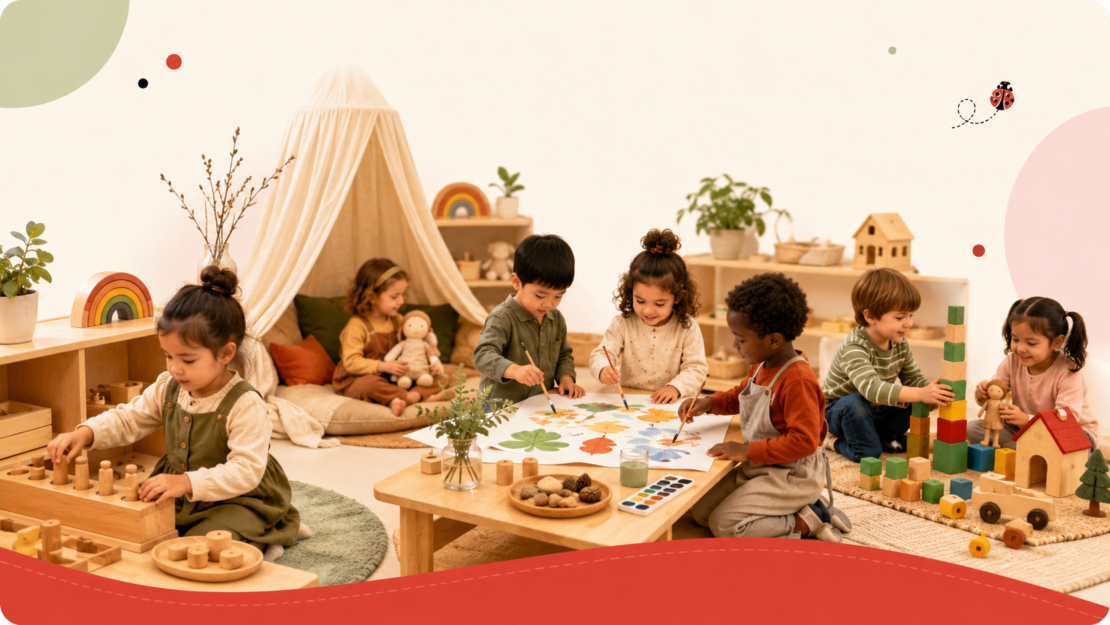
Somewhere between the first daycare tour and the fourth, parents hit a wall of vocabulary. One center brings up Montessori, the next mentions Waldorf or play-based learning, a third talks about Reggio Emilia (isn’t that in Italy?), and they all claim theirs is the approach that will set your child up for life. If you’ve caught yourself nodding along while quietly wondering what any of it actually means, and what are the real differences, then you’re in very good company.
The good news is that all of these are solid options for your child. They are all well-established ways of helping young children learn, and plenty of happy, well-adjusted kids have graduated from these schools.
We’ll walk you through what makes each approach different, what a normal day tends to look like, the trade-offs, and how to work out which one suits your little one.
Montessori vs Waldorf vs Reggio Emilia, in a nutshell
Here’s a quick breakdown of each approach: Montessori is about independence and hands-on materials, Waldorf is about imagination, rhythm and an unhurried childhood, and Reggio Emilia follows the child’s own curiosity through projects. Play-based learning, the most common style in American daycares, treats play itself as the main way young children learn. And most real programs, including ours, borrow from more than one of these rather than following a single rulebook.
| Approach | How children learn | Classroom feel | Academics start | Best suited to |
|---|---|---|---|---|
| Montessori | Independent, hands-on work with special materials, at the child’s own pace | Calm, orderly, low open shelves | Early, around age 3 | Children who like order and doing things on their own |
| Waldorf | Imaginative play, story, art, music and nature, on a steady daily rhythm | Cozy and homelike, natural toys, screen-free | Later, around age 7 | Dreamy, creative kids; families wanting a slower childhood |
| Reggio Emilia | Child-led projects that follow the children’s own interests and questions | Thoughtfully arranged, natural light, real materials | Woven into projects, no set timeline | Sociable, expressive kids who love to make and build |
| Play-based | Guided play: blocks, pretend, art and outdoor exploration | Busy and flexible, with lots of activity areas | Introduced gently through play | Almost any young child; flexible for working families |
What is the Montessori approach?
In a Montessori classroom, children choose their own work from a set of carefully designed materials, and teachers guide rather than direct.
The method comes from Dr. Maria Montessori, an Italian physician who opened her first classroom in Rome in 1907. Montessori classrooms today tend to feel calm and tidy, with low shelves of wooden materials that each teach one specific thing, such as sorting, letters or numbers. Children move around freely and pick what they want to work on, often for long uninterrupted stretches, while teachers watch closely and step in when needed.
Ages are usually mixed, so a five-year-old might help a three-year-old out, while things like reading, writing and math are introduced early, often around age three. If your child likes order, enjoys figuring things out alone, and gets real satisfaction from finishing a task, Montessori can be a lovely fit.
Worth knowing: authentic Montessori programs can be expensive, and because the name is not trademarked, quality varies a lot from one center to the next. The American Montessori Society keeps a directory if you want to check a school’s credentials.
What is the Waldorf approach?
A Waldorf preschool offers a warm, homelike setting where young children learn through play, story, art and the rhythm of the day, with formal academics saved for later.
Waldorf education grew out of the ideas of Rudolf Steiner, who opened the first Waldorf school in Germany in 1919. A Waldorf early-childhood room is designed to feel cozy and relaxing rather than school-like, with soft lighting, natural materials, and simple toys that leave plenty of room for imagination. Days follow a steady rhythm, and a big chunk of time is set aside for open-ended play sessions, songs, and being outdoors.
One thing that surprises parents is that Waldorf holds off on formal reading and math until around age seven, the thinking being that early childhood is a time for playing, moving and wondering. That doesn’t mean children learn nothing in the meantime, as they take in a great deal and pick up skills through art, music and daily life. Waldorf tends to suit dreamy, imaginative, creative children who benefit from a slow, screen-free childhood.
Worth knowing: the later start on academics makes some parents nervous, and Waldorf’s roots include a spiritual philosophy called ‘anthroposophy’ that shows up to different degrees depending on the school, so it’s fair to ask about it and check whether that appeals to you or not.
What is the Reggio Emilia approach?
Reggio Emilia is an approach built around children’s own questions and interests, explored through long-running projects, with the classroom treated as a second teacher of sorts.
The Reggio Emilia method of learning is named after the town in northern Italy where it first emerged after World War II, led by an educator named Loris Malaguzzi together with a group of parents who wanted something better for their children. It actually started with infants and toddlers, which is part of why it works so naturally in the daycare years. The idea at the center of it is that children are capable and curious, and that the adult’s job is to follow their interests and passions rather than impose a fixed curriculum.
In practice, that looks like projects. If the children become fascinated by shadows, or worms, or the construction site down the block, the teachers help them dig into it for as long as the interest lasts. Teachers keep track of what children say and make, and the room is arranged with a lot of care, plenty of natural light and real materials, because Reggio treats the environment as a kind of teacher in its own right. This approach suits sociable, curious, expressive children who love to make and build. If Waldorf is often a great option for anxious, more introverted children, Reggio is a better fit for extroverted, outgoing kids.
Worth knowing: Reggio is more of a philosophy rather than a certified program, so there is no official stamp to look for, so you are relying on how well a given center truly understands and lives by it.
What is play-based learning?
Play-based learning is the approach most daycares use, where carefully set-up play is the main learning engine for young children.
Rather than sitting kids at desks, teachers set up the room and the day so that children learn through play, building with blocks, cooking in a pretend kitchen, digging outside, painting, and working things out with friends. It’s easy to underestimate because it looks like ‘just playing,’ but there is a lot of research behind it. The American Academy of Pediatrics has written about the power of play for building language, problem-solving and the ability to manage big feelings, while NAEYC treats play as central to how young children learn best.
Good play-based programs are not a free-for-all, though. Teachers guide the play sessions with a purpose, slipping in counting, letters and early science as they go, which is sometimes called guided play. This is where you will hear the phrase ‘developmentally appropriate,’ meaning the day is built around how three- and four-year-olds actually learn instead of shrinking down a grade-school classroom. A play-based preschool suits almost every young child, which is a big part of why it is so common.
Worth knowing: the quality leans heavily on the teachers, since good guided play takes real skill, so it’s worth watching how the staff talk and play with the children when you tour.
Does the approach even matter before age three?
If you’re looking for infant or toddler care, you really don’t need to overcomplicate things. For babies and young toddlers, the philosophy on the sign matters far less than the people who work there. Children under three learn mainly through warm, responsive relationships, by being held, talked to, comforted and kept safe. A gentle, attentive caregiver in a plain room will do more for a one-year-old than any fancy label or philosophy could.
What counts much more at this age is the ratio of adults to children, teachers who stay long enough for your child to bond with them, and a clean, safe, loving space. In Illinois, the Department of Children and Family Services sets the minimum, one adult for every four infants and one for every five younger toddlers, and it is perfectly fair to ask a center how close they stay to those numbers, since smaller groups mean more lap time and attention.
Our infant, toddler and twos rooms are built around exactly that: consistent teachers, small groups and a lot of attention and affection, with the learning folded gently into the day. As children grow into the preschool years, the differences between approaches start to matter more, and that is when each option is worth a closer look.
Common misconceptions, debunked
Is Montessori actually good, or is it just overhyped? The research on Montessori is generally positive, especially for independence and early academic skills, and many children thrive in it. The criticisms you’ll find online usually come down to cost, the occasional rigidity, and the fact that some centers borrow the name without the training to back it up. A good Montessori program can be a great option, but the label on its own is no guarantee.
What about Waldorf, isn’t it behind on reading and math? It can look that way on paper, though there are two sides to the coin. Waldorf children tend to start formal academics later and then catch up, and many families feel the trade for a slower, play-rich early childhood is well worth it. If your four-year-old is already hungry to read and learn, however, a strict Waldorf setting might feel like it’s holding them back.
And play-based learning, isn’t that just babysitting with toys? The difference between a strong play-based room and plain babysitting is the teacher. In a good program, you will see adults asking questions, adding new words, stretching a game just enough to build a skill, and quietly steering play toward counting or storytelling. Watch closely on a tour and you can usually tell within a few minutes if it’s the right kind of room for your kid.
How to tell which approach a daycare actually uses
A center can put any of these fancy words and philosophies on its website, yet that label doesn’t tell you what happens on a daily basis. The surest way to know is to visit, watch a class in progress, and ask a few direct questions:
- How do children spend a typical morning here, minute by minute?
- How much of the day is chosen by the child versus led by a teacher?
- When and how do you introduce letters, numbers and reading?
- What training do your teachers have in this particular approach?
- How do you handle a child who learns very differently from the group?
For a fuller list of what to ask on a visit, our guide to the 25 questions to ask a daycare covers safety, teachers and curriculum in detail, and if you are still sorting out the difference between daycare and preschool, we cover that, too.
The bottom line is there is no single best preschool approach for every child. Montessori often suits children who enjoy order and independent work, Waldorf favors imagination and predictable rhythms, Reggio Emilia works well for children who enjoy collaborative projects, and play-based learning is the most flexible choice for a wide range of personalities. The quality of the teachers and the individual classroom usually matter more than the label.
No written guide can really tell you how a daycare feels, so the best way to choose is to visit a few and watch how the teachers interact with the children. If you’re in the Chicago area and would like to see a warm, play-based day up close, you are always welcome to book a visit at your nearest LadyBug & Friends.
Frequently asked questions
What is the main difference between Montessori and Waldorf?
Montessori centers on independent, hands-on work with structured materials and introduces academics early, around age three. Waldorf centers on imagination, art and play in a homelike setting and holds off on formal reading and math until about age seven. In short, Montessori leans toward structured independence while Waldorf leans toward unhurried, creative play.
What is play-based learning?
Play-based learning is an approach where young children learn mainly through play, such as blocks, pretend, art and outdoor exploration, guided by teachers who weave in early skills like counting and letters. It is the most common style in American daycares and is well supported by research on how young children learn.
What is the difference between Reggio Emilia and Montessori?
Both respect children as capable learners, but Montessori uses a set sequence of specific materials, while Reggio Emilia follows children’s own interests through open-ended projects with no fixed curriculum. Montessori is more structured, and Reggio is more emergent and child-led.
Does the preschool approach matter for babies and toddlers?
Much less than you might expect. Under age three, warm and consistent caregivers, small group sizes and a safe space matter far more than any teaching philosophy. The approach becomes more important once children reach the preschool years.
Which approach is best for a shy child or a very active child?
A shy child often does well in a warm, predictable setting such as Waldorf or a nurturing play-based room, where there is no pressure to perform. A very active child usually thrives with plenty of movement and hands-on choice, which play-based and Montessori rooms tend to offer. Watching how a program handles both energy and quiet on a tour tells you a lot.
Can a daycare combine more than one approach?
Yes, and most good ones do. Plenty of programs borrow the best of several philosophies, the independence of Montessori, the creativity of Reggio, and the play and warmth that suit young children, rather than following a single method. A thoughtful blend is common and can be a real strength.
Get Enrollment Information and Register for our Tours & Waitlist…
Other News
Separation Anxiety at Daycare, When it Starts and When It Gets Easier
Separation anxiety usually starts around 9 months and returns in toddlerhood. Learn when t …What Age Does Preschool Start?
What age does preschool start? Typical ages from 2 to 5, what changes when a child turns 3 …How to Prepare Your Child for Daycare, Week by Week
How to prepare your child for daycare, week by week: Illinois health forms, moving naps an …What to Expect from Infant Care at Daycare: A Parent’s Guide
A complete guide to infant daycare in Chicago: ratios, daily routines, bottles and meals, …How Daycare Waitlists in Chicago Work and When to Apply, By Age
Daycare waitlists in Chicago run longest for the youngest children, since state ratios kee …Private vs Public Preschool in Chicago: Hours, Calendar and Starting Age
Public Pre-K is free and follows the school-year calendar, making it a strong choice for f …More News